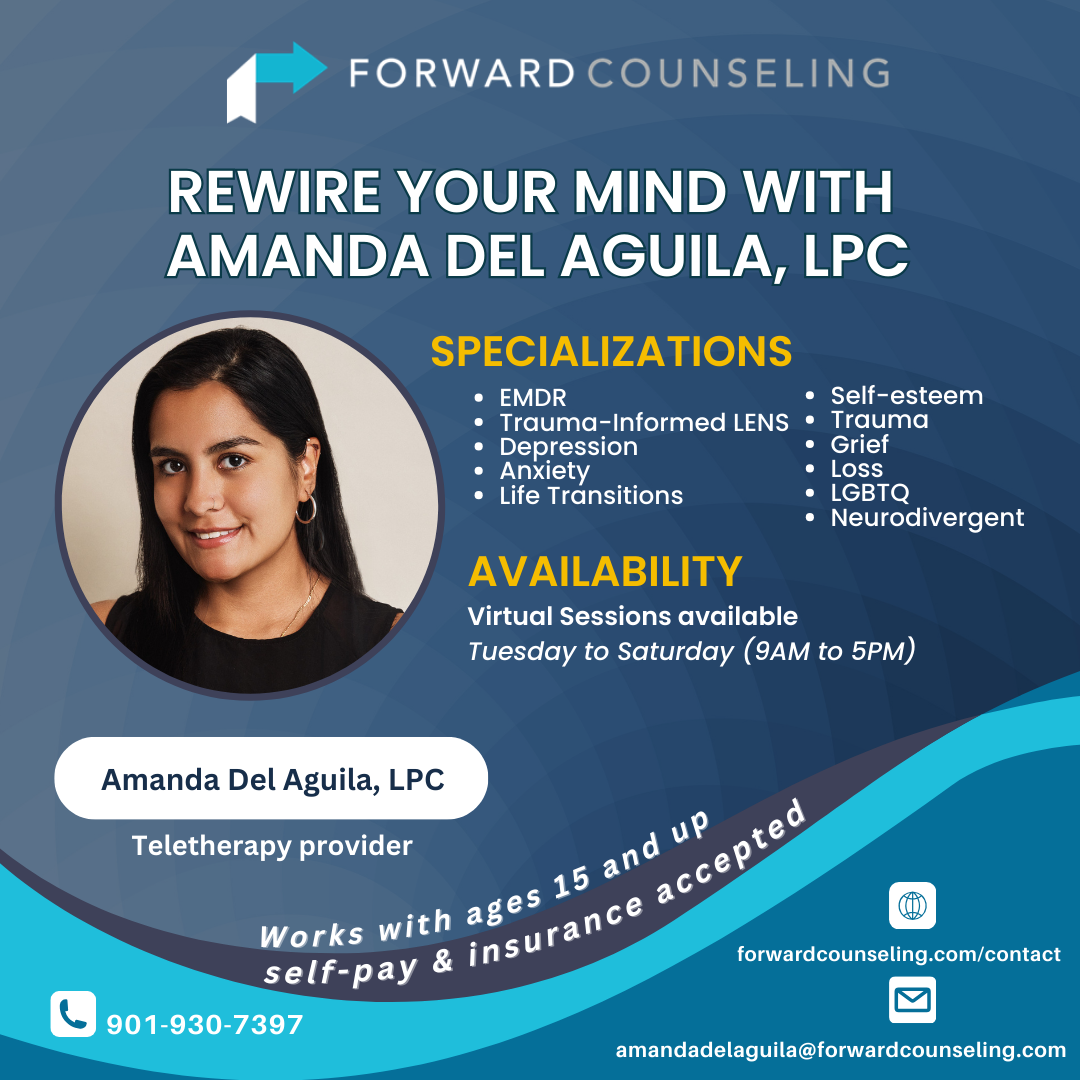
Rewire your mind with Amanda Del Aguila, LPC
/
The decision to begin therapy is often sparked by a desire to reconnect with one's true self, and for Forward Counseling’s new provider, Amanda del Aguila, LPC, that journey is deeply personal.
Inspired by her own transformative experience of being "emotionally held" by a therapist, Amanda has dedicated her career to providing that same powerful, nonjudgmental sanctuary for others.
She views therapy not as a process of "fixing" a broken person, but as a collaborative strength-based partnership designed to unlock the abundance of resilience already living within each client.
Whether you are navigating the complexities of a neurodivergent identity, moving through the fog of a major life transition, or seeking a queer-affirming space where you can finally exhale, Amanda invites you to step out of "survival mode" and into a life that feels truly aligned with who you are.
Join our Q&A session with the newest provider at Forward Counseling and discover how Amanda can help you on your healing journey. 🧠
What inspired you to become a mental health therapist, particularly an LPC?
I believe what inspired me most to become a mental health therapist was my own mental health journey and how helpful therapy was for me in exploring who I was as a person, how my past influenced behaviors in the present, and how I could find the strength within myself to be the person I wanted to be. Being able to sit and be emotionally held by another human being was incredibly healing and powerful in my ability to witness firsthand how helpful mental health professionals could be, and I knew that I wanted to be that for others. I specifically chose to become an LPC because I knew how much I valued that one-on-one connection, and I was able to recognize that growth and progress felt tangible in that therapeutic setting. That is why creating a safe, therapeutic space for my clients is one of the most important aspects of being a therapist for me; I want my clients to know they can trust in my ability to emotionally hold what they would like to share, and that I will work with them to move towards the goals they set for themselves. I want them to know we are in this together.
2. You mention that the therapeutic relationship is the primary driver of "deep, meaningful, and lasting change"—how do you go about building that initial trust with a new client?
I prioritize the therapeutic relationship and build initial trust with my clients by being open about the therapeutic process, reminding them that I will move at a pace that feels comfortable and right for them, encouraging them to voice any questions, concerns, or thoughts they might have about therapy, and also reminding them that I encourage and value any feedback they may have about therapy, what they need from me as their provider, and how they prefer to work through their therapeutic goals.
3. Your philosophy focuses on empowering human beings rather than "fixing" them; how does this strength-based approach change the way a client views their own mental health journey?
I believe this strength-based approach works in tandem with an abundance mindset, essentially stating that many aspects people seek are already within themselves and that strength is not scarce but plentiful. This also supports the belief that people have the innate capacity to meet the many challenges and changes of life, and to focus on strength encourages my clients to recognize and embrace the individual power they have in navigating their mental health journey.
4. You describe therapy as a tool to help people live a "more authentic life"—what are some common signs that someone might be living out of alignment with their true self?
Some common signs I have noticed may include feeling lost, uncertainties related to the future or what someone wants for themselves in the present, struggling with friendships and interpersonal relationships, and feeling as though there might be a lack of clarity in values, beliefs, thoughts, and feelings. I believe therapy helps to bring clarity to many of these issues by exploring with the client what they feel is right for them and how they want to live a life that feels more aligned with who they want to be.
5. Since you view therapy as a collaborative process where the client chooses the destination, how do you help someone who feels "stuck" or isn't quite sure where they want to go yet?
I like to explore with my clients the parts of themselves that they believe are keeping them in a “stuck” space. Often, this helps my clients explore various parts of themselves, bringing awareness to these parts, and working together to understand how some parts attempt to keep them safe, which may outwardly appear as being “stuck.” I attempt to reassure my clients that the answers they seek are within themselves, but the collaboration comes from us working together to unlock those answers within.
6. As a neurodivergent and queer-affirming therapist, what specific elements do you incorporate into your practice to ensure these clients feel truly seen and validated?
I believe the specific elements I utilize to ensure my clients feel seen, validated, and accepted for who they are are my nonjudgmental stance and humanistic way of connecting with people. I want every client I work with to truly know and feel that I will not judge them for who they are, that I have no agenda, no ulterior expectation, and that I want them to feel embraced in a space where they are free to be who they are. My intention is not to tell people who they “should” be, but to help them connect to the version of themselves they fully embrace, understand, and feel authentic in being.
7. How do you weave multicultural and holistic techniques into your treatment plans to ensure care is tailored to a client’s unique cultural background?
I attempt to understand and see my clients in their entirety and acknowledge the intersectionality of all the identities they move through life with. This comes with a deep respect for and value of human beings as a whole, and I intend to be mindful of the way people are shaped by the world around them and the cultures they embrace. I also pay attention to the mind-body-spirit connection, ensuring that I acknowledge how the entire system is connected and acknowledge that we are far more than the sum of our parts.
8. You have extensive experience with life transitions—what is one piece of advice you often give to those feeling overwhelmed by a major life change?
I think one thing I try to instill in the clients I work with is the concept of their internal strength and their ability to adapt to the many changes of life, emphasizing their power and capacity as a human being to keep moving forward, acknowledging all of the steps they have taken and all the battles they have overcome so far in their lives.
9. These are heavy "roles" to carry; how do you help clients create a "safe and secure" internal space while they process past trauma or loss?
I believe the most important aspect of creating an internal space to process the heaviness of life is to emphasize the notion that there is no “set time” to process things. Our bodies and minds are all unique, and every person differs in what they need to feel safe and secure in their processing, but there is no rush, there is no deadline, and there are no external expectations placed on those I work with. I encourage my clients to truly come as they are and to take the time they need, knowing that I will walk along with them on their journey for however long they need me to.
10. Many potential clients are nervous about their first session; what can they expect when they step into the nonjudgmental space you’ve cultivated at Forward Counseling?
Meeting someone new in any capacity is understandably an anxiety-inducing process due to all of the unknowns of starting something new. Still, I do my best to introduce myself and the therapy process openly, inviting questions, thoughts, and concerns, and encouraging new clients to tell me what they feel comfortable with and their preferences related to the work we will do together. When working with new clients, I try my best to cultivate an open, welcoming, and inviting space, where I move at a pace that feels comfortable for my clients and encourage them to take the lead in their sessions. I intend to create a space for my clients where they know they are welcome to bring in any element or part of themselves they would like to explore or simply begin to put words to, with the understanding that I provide an open, caring, and non-judgmental space to hold it all with them.
At the heart of Amanda’s practice is the unwavering belief that there is no deadline for healing and no "right" pace for processing the weight of trauma or loss. By externalizing the problems that feel like permanent flaws and deconstructing the "shoulds" imposed by the world, she helps her clients cultivate an internal safety that persists long after the session ends. Stepping into the room with Amanda means entering a space where your intersectionality is respected, your "invisible wins" are celebrated, and your autonomy is the guiding compass. As you close the chapter on who you were told to be and begin authoring a narrative of your own design, Amanda remains a steadfast witness to your growth—reminding you at every turn that you have the innate power to move forward, and you certainly don't have to do it alone.