Navigating Loss Together: FAQs About Our Managing Grief Group with Trina Rogers, LPC-A
/The hardest part of grief isn’t always the weight of the loss itself—it’s the moment your hand rests on the doorknob of a room where you’re expected to speak it out loud.
Perhaps you’ve been navigating the fog for just a few days, or maybe you’ve been silently bearing it for weeks, months, or even years.
You may have been the strong one—holding it together for your family, pushing through the workday, and burying the sudden, unpredictable waves of loss beneath a carefully composed surface.
But grief wasn't meant to be carried in isolation forever.
Stepping out of survival mode and into a supportive space is made lighter and easier because we’ve unraveled the answers to the questions you might be asking yourself right now.
To help you feel confident and prepared, we’ve compiled answers to the most common questions about our Forward Counseling’s in-person Managing Grief support group—led by Trina Rogers, LPC-A—covering everything from clinical eligibility and session logistics to handling big emotions like anger, anxiety, and tears in a group setting.
Q1: Who is this grief group specifically for?
It's designed for adults who have experienced any type of significant loss—whether that's a person, a job, a pet, or an expectation—and are noticing that the grief is interfering with their daily functioning, focus, or emotional well-being.
Q2: What actually happens during a 90-minute group session?
Each Saturday at 9:00 AM, we gather in a small, comfortable setting (with coffee and breakfast snacks!). We follow a structured, trauma-informed 5-week curriculum. You’ll explore how grief impacts your mind and body while working through interactive tools, reflection exercises, and supportive group discussions.
Q3: Do I have to wait for a specific start date to join?
No! Because we use a rotating 5-week curriculum, eligible participants can join in as long as there is an open spot in our 3 to 6-person group.
Q4: How do I know if I’m eligible, and how does the screening work?
We want to make sure this group is clinically appropriate for where you are in your healing journey. We use two quick, standard screening tools.
Q5: What are the location, pricing, and insurance details?
We meet in person at our Poplar Ave office in Memphis (Suite 302). We accept major insurance plans, and our standard self-pay rate is $65 per 90-minute session.Q6: Isn't sitting in a room full of grieving people going to make me feel even worse?
This is a valid concern. That's one reason why the group structure includes a combination of guided processing and skills development. You will be met with compassion as we learn effective ways of navigating your specific grief experience.
Q7: What if my loss isn't 'big enough' compared to everyone else's?
We actually talk about this as part of the group curriculum. The truth is that there’s no standard scale for measuring grief. Each person's grief experience is unique to them. Our focus in group will be supporting how you function with grief in your everyday life.
Q8: Am I going to be forced to spill my deepest feelings to strangers on day one?
To support how uncomfortable it can be to share your feelings with others, this group uses guided processing. These processing questions help members better understand what they're experiencing. If sharing feels uncomfortable for you, these questions can also be used as independent reflective exercises for you to do on your own outside of group. Sharing in group is always optional but it can greatly increase your benefit out of the experience.
Q9: I'm super busy on weekends. Is 5 weeks a massive commitment?
As this is an open group, participants may join when there is space available and are not required to attend all 5 weeks. We use a rotating 5 weeks curriculum with a different topic each week. If you're not able to attend 5 consecutive weeks, there will be another opportunity in an upcoming cycle.
Q10: What if I start crying and literally can't stop?
For many, the grieving process will produce many tears. This is a normal reaction. Our curriculum includes learning skills to help regulate when you feel like those moments become overwhelming.
Q11: I feel like I'm doing 'grief' wrong because I'm not crying all day. Is that weird?
Grief is a personal experience and absence of tears does not invalidate that you’re grieving. You’ll hear from other group members about ways that they're experiencing grief completely different from your experiences as well. All are still valid.
Q12: It’s been over a year since my loss... shouldn't I be over this by now?
This is a common misconception. The truth is that grief doesn't have a standard timeline. Part of our curriculum is learning some of the different ways that grief manifests, including what it can look like over longer periods of time.
Q13: I'm usually the strong person in my family/friend group who takes care of everyone else. How do I even shift into receiving support?
For those struggling with receiving support, you can start with self-compassion. Just as those that you care for deserve care, you deserve care also. Helpful practices that you can start are trying affirmations (such as the one in the previous sentence) and practicing self-care habits, even small ones. These can also be helpful when processing grief.
Q14: Is this going to conflict with my individual therapy sessions?
Group therapy can be a great compliment to individual therapy! Make sure to inform your provider of your attendance so that it can be included in your goals or treatment plan.
Q15:What if there’s an awkward silence during group and nobody talks?
Many individuals struggle with silence, for various reasons. However, therapy can include the use of therapeutic silence to allow reflection or bring awareness to something. With the many stimuli of our day-to-day, we may miss connecting with our internal experiences. So if you find yourself growing uncomfortable during a group silence, try to use that time to examine your inner experience and share with the group when you're ready.
Q16: I'm worried I'll run into someone I know in Memphis. Is this truly private?
As this is an open group, anyone that fits the stated demographics of the group in the local area may attend. The staff will maintain confidentiality for all members and group members are asked to respect each other's privacy by not sharing group details outside of session. If you ever feel uncomfortable in the group space, tell the facilitator.
Q17: What if I get angry? Like, really angry about my loss?
Anger is a very common grief experience and learning healthy ways to express anger related to grief is part of the curriculum. Please be assured that we'll maintain safety measures for all group members. Don't be afraid to acknowledge the anger so that we can work with it together.
Q18: Do I have to do homework between the Saturday sessions?
You’re encouraged to practice what you learn in session in your daily life. This is how you identify effective skills and practices for your own needs.
Q19: What if I miss a Saturday because life happens?
As this is an open group, participants may join when there is space available and are not required to attend all 5 weeks. We use a rotating 5 weeks curriculum with a different topic each week. If you're not able to attend 5 consecutive weeks, there will be another opportunity in an upcoming cycle.
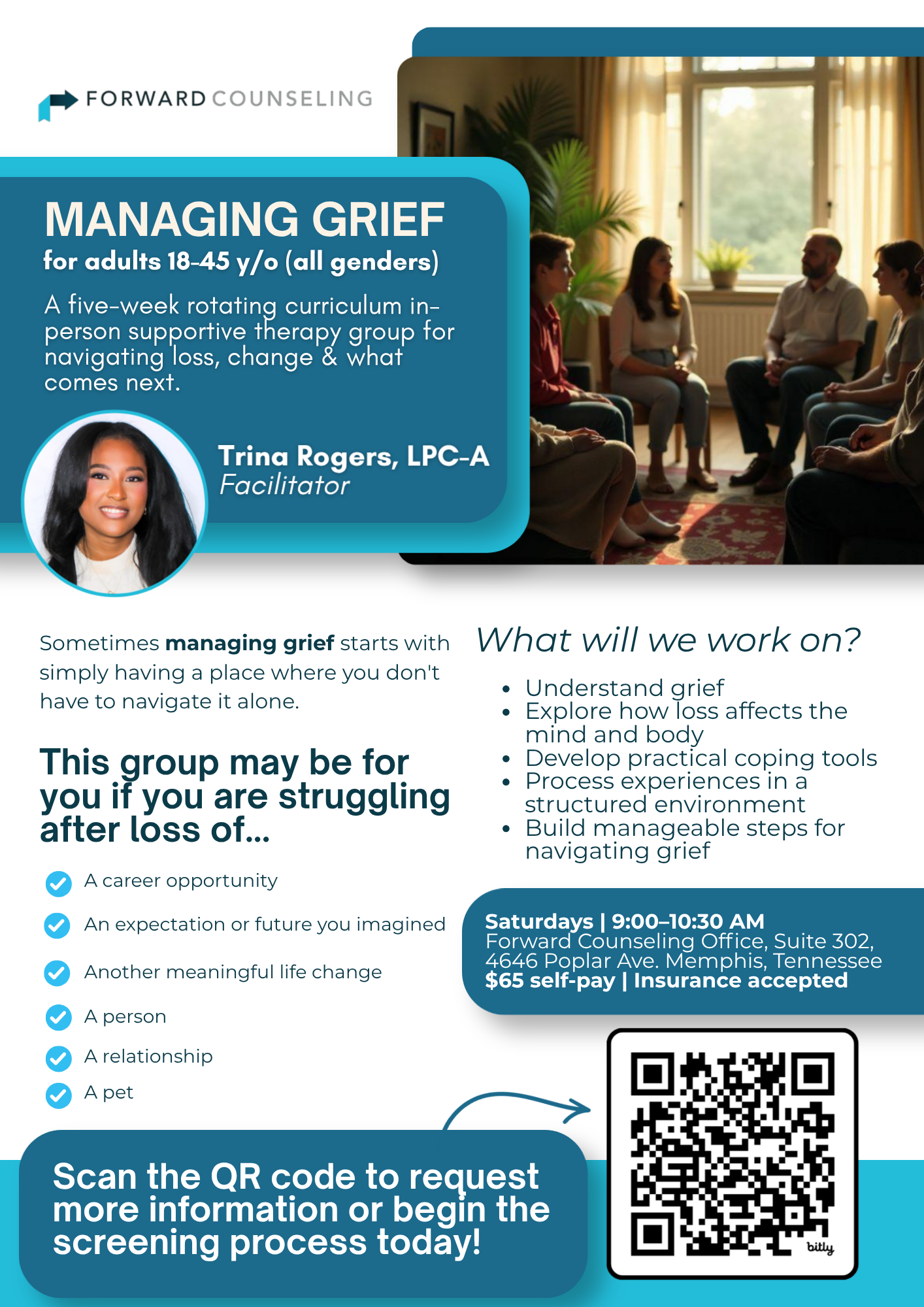
Healing from grief isn't about reaching a deadline or forgetting what you’ve lost—it’s about discovering how to carry your experience forward while restoring emotional balance in your everyday life. Whenever you feel ready to take the next step in your healing journey, scan our QR code or reach out to our intake team to complete your digital screening and reserve your spot.